
I know how frustrating it is to clean your glasses, put them back on, and still see a greasy streak sitting directly in your field of vision. A microfiber cloth may spread the oil, disposable wipes eventually run out, and carrying a bottle of cleaning spray everywhere is not always practical.
That everyday problem is what makes this Peeps Eyeglass Cleaner Review worth reading. Peeps combines a retractable dust brush with two carbon-based cleaning pads designed to clean both sides of a lens without liquid. The concept sounds convenient, especially for work, travel, and quick touch-ups, but convenience alone does not make a product worth buying.
This review looks at how Peeps works, what it can realistically clean, where it may fall short, its lens-safety concerns, current buying considerations, and whether it offers better value than a microfiber cloth, lens wipes, or a traditional spray-and-cloth routine for everyday U.S. buyers.
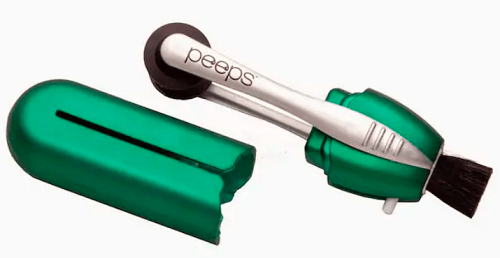
Peeps By CarbonKlean is an advanced quality eyeglass cleaner that implements the latest aerospace technology to clean your lenses without getting streaks. The device works by producing ions that loosen the dirt and grime and make it easy to wipe away
- Built with high-quality materials
- Safe to clean all types of lenses
- Very lightweight and portable
- Approved By NASA
- Sometimes pads fall off
- Need to change the pads after 500 times
Quick Verdict
Peeps works best as a portable cleaner for fingerprints, facial oil, light dust, and everyday smudges. Its built-in brush and reusable carbon-based pads require no spray, making it convenient for work or travel. It should not replace proper washing when lenses contain grease, sticky residue, sand, salt, or visible grit.
Best for: Daily glasses wearers who need quick, liquid-free touch-ups away from home.
Not ideal for: Buyers who mainly need deep cleaning, already protect a clean microfiber cloth, or own specialty lenses with strict care instructions.
What Is the Peeps Eyeglass Cleaner?
Peeps is a reusable, liquid-free eyeglass cleaner that combines a retractable brush with two opposing carbon-based pads. The brush removes loose dust first, while the pads sit on both sides of a lens and wipe away fingerprints, facial oil, and light smudges in one motion.
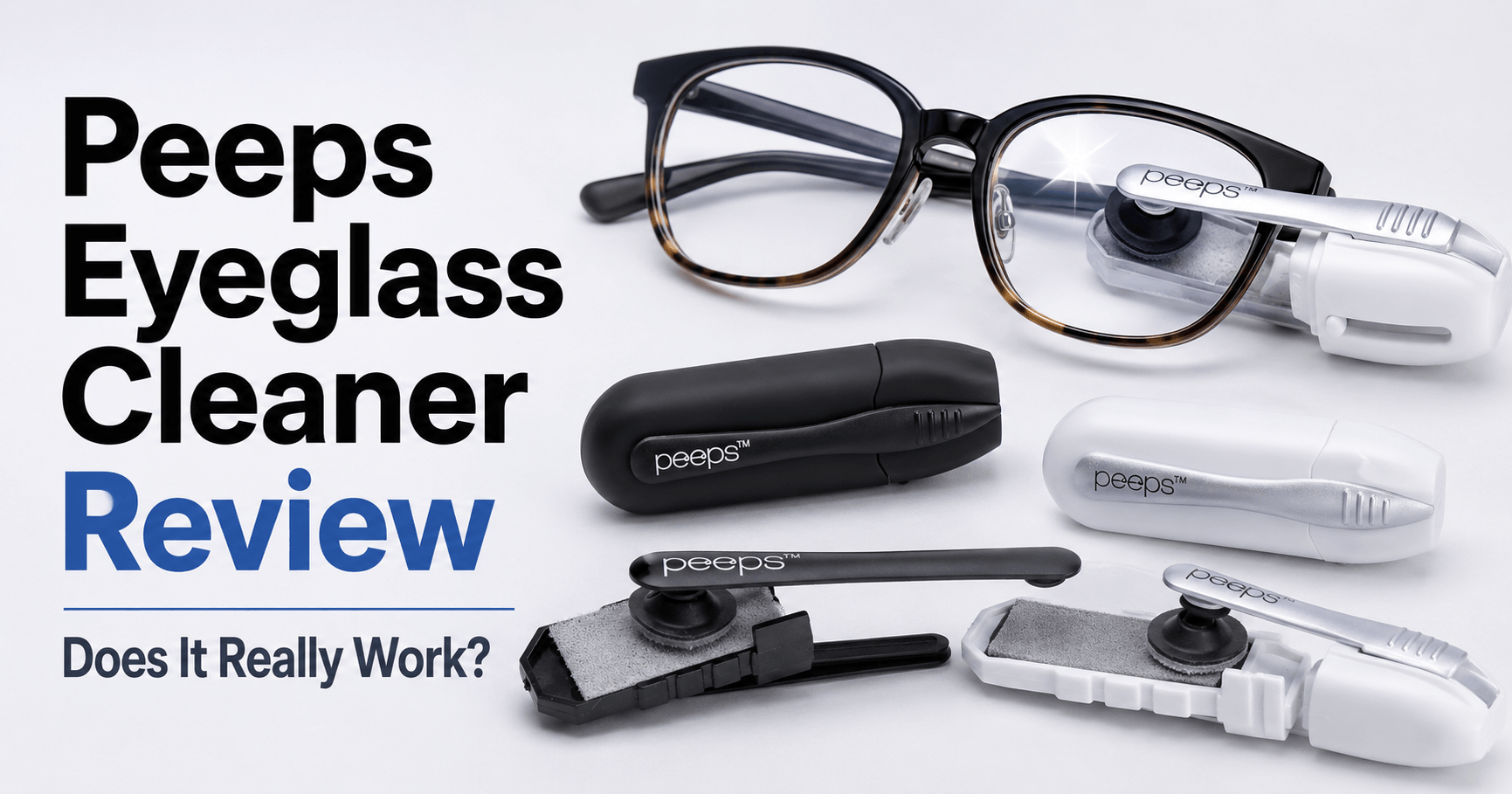
The product looks more like a compact pair of tongs than a traditional cleaning cloth. One end contains the brush. The other opens into two padded arms, allowing the front and back of a lens to be cleaned together.
That design gives Peeps a clear purpose. Instead of using one cloth to handle both dust and oil, it separates the job into two steps:
- Remove loose particles with the brush.
- Clean oily marks with the pads.
The manufacturer markets Peeps for prescription glasses, reading glasses, sunglasses, and coated lenses. It also claims that the pads can provide up to 500 cleanings. That number should be treated as a brand claim rather than a guaranteed lifespan for every buyer.
Peeps Product Snapshot
| Product detail | What buyers should know |
| Product category | Reusable eyeglass and lens cleaner |
| Cleaning system | Retractable brush plus two opposing carbon-based pads |
| Liquid required | No |
| Best use | Fingerprints, facial oil, light dust, and minor smudges |
| Claimed lifespan | Up to 500 cleanings |
| Lens compatibility | Marketed for common prescription and coated lenses |
| Replacement parts | Replacement pads are sold separately |
| Main limitation | Not intended for heavy, sticky, wet, or gritty residue |
| Best setting | Desk, purse, backpack, travel bag, or glasses case |
How Does Peeps Work?
Peeps uses a two-step dry-cleaning process: brush away loose particles, then place the carbon-based pads around the lens to remove oily marks from both sides. The order matters because wiping a dusty lens without removing debris first can increase friction and reduce cleaning quality.
Step 1: Brush Away Loose Dust
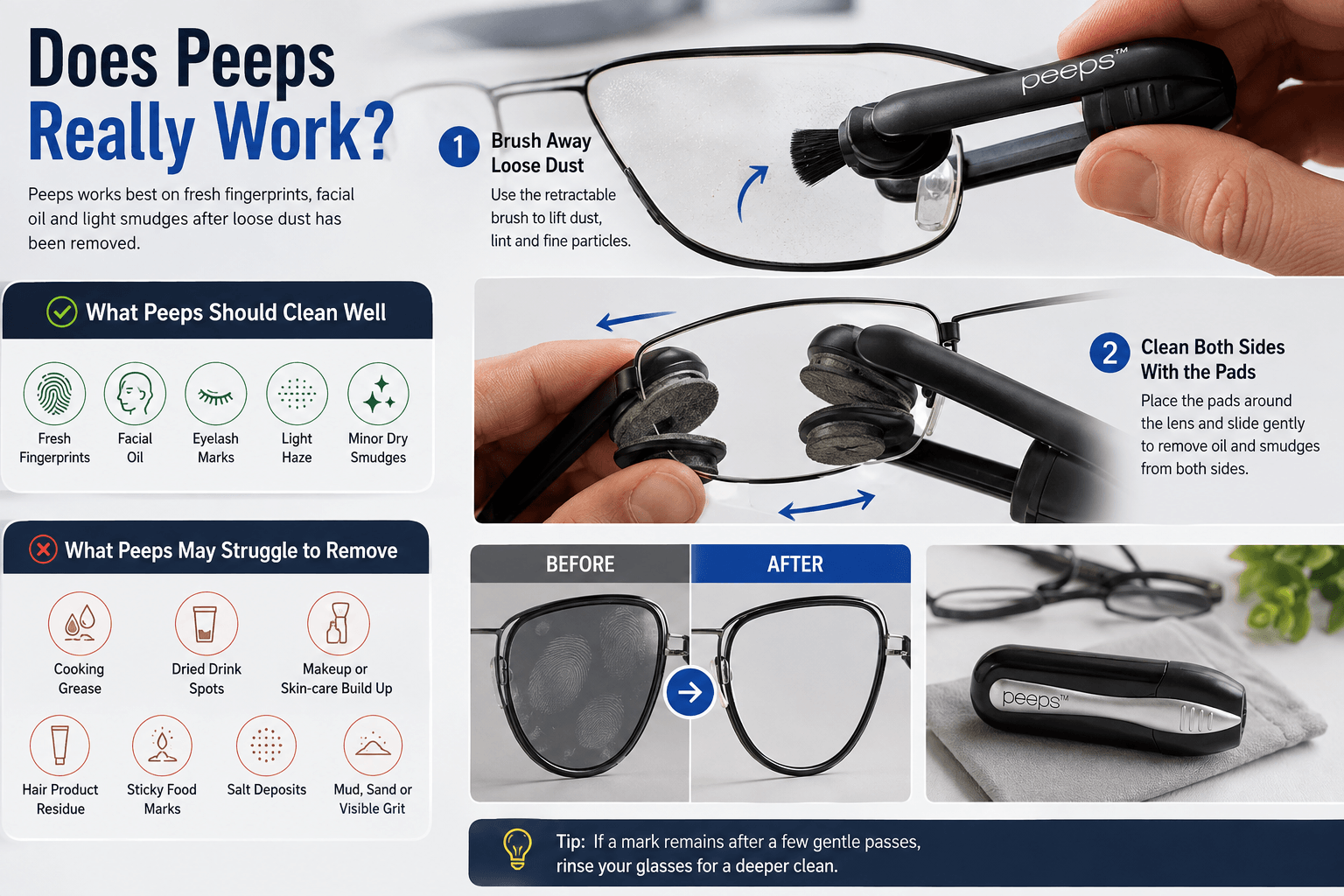
The retractable brush is designed to lift loose dust, lint, and fine particles from the front and back of each lens.
I would not treat this as an optional step. Even a soft cleaning surface can become risky when a hard particle is trapped underneath it. Brushing first helps reduce the chance of dragging debris across the lens.
However, the brush has limits. It should not be expected to remove everything safely. If the glasses have been exposed to sand, mud, dried salt, construction dust, or particles that appear stuck to the lens, rinsing is the safer option.
Step 2: Clean Both Sides With the Pads
After brushing, the tweezer-style arms open around the lens. One pad rests on the front, and the other rests on the back. A gentle sliding motion allows the device to clean both surfaces together.
The pads are intended for common daily marks such as:
- Fresh fingerprints
- Facial oil
- Eyelash marks
- Light haze
- Minor dry smudges
Some product descriptions say the pads are “recharged” when the cleaner is returned to its body. I would treat that as marketing language. It does not necessarily mean heavily contaminated pads become completely clean every time they are stored.
What Peeps Is Not Designed to Do
Peeps is a maintenance tool, not a complete eyewear-care system. It is not a disinfectant, scratch remover, lens-polishing tool, or replacement for proper wet cleaning.
That limitation does not make the product useless. It simply defines the job it is most likely to perform well: removing light, everyday smudges when a full cleaning setup is unavailable.
Does Peeps Really Work?
Peeps should work best on fresh fingerprints, facial oil, and light smudges after loose dust has been removed. It is less suitable for dried residue, sticky substances, heavy grease, or lenses exposed to sand and grit. Results can also decline when the pads become dirty, damp, or worn.
What Peeps Should Clean Well
Fresh fingerprints are the strongest use case because they are usually made of light skin oil sitting on the lens surface. A dry carbon-based pad can reasonably target that type of residue without requiring spray.
The same applies to faint haze caused by facial oil, eyelashes, or repeatedly adjusting the frame. These marks can become distracting under office lights, computer screens, or sunlight, yet they do not always justify a full wash.
This is where Peeps offers the most practical value. A smudge appears during a meeting, commute, flight, or workday. A sink is not nearby, and the microfiber cloth in your bag may be missing or dirty. Peeps gives you a protected, compact tool for a quick correction.
What Peeps May Struggle to Remove
Dry pads are less effective when residue has hardened or contains more than light oil. Common examples include:
- Cooking grease
- Dried drink spots
- Makeup or skin-care buildup
- Hair-product residue
- Sticky food marks
- Salt deposits
- Mud, sand, or visible grit
These substances often need moisture to loosen or carry them away. Continuing to rub a stubborn mark with dry pads may spread the residue or increase friction.
If a mark remains after a few gentle passes, I would stop rather than squeeze harder. The glasses probably need rinsing and a proper lens-safe wash.
Why Buyer Results May Differ
Two buyers can use the same product and report very different results. One may clean only fresh fingerprints using clean, dry pads. Another may use the cleaner on old grease, moisture, or makeup.
Frame shape also affects the experience. Large open lenses are easier to reach than small, curved, rimless, or thick-framed glasses. Pad condition matters as well. Once the pads collect too much oil or contamination, they may begin spreading a film rather than lifting it.
My conclusion is straightforward: the design makes sense for quick daily touch-ups, but Peeps is not a universal cleaner for every type of lens contamination.
When Is Peeps Most Useful?
Peeps is most useful when you need to remove a fingerprint or light oily film and do not have access to a sink, spray bottle, or reliably clean cloth. Its portable design makes it especially practical for office desks, commutes, flights, road trips, conferences, and sunglasses used throughout the day.
At Work or School
Fingerprints become more noticeable against bright monitors, classroom screens, and overhead lighting. A compact dry cleaner can remain in a desk drawer or laptop bag without creating spray near electronics or paperwork.
During Travel
A liquid-free cleaner is easier to carry than a bottle and separate cloth. The brush and pads stay inside the device, which helps protect them from loose lint and dust inside a purse or backpack.
For Sunglasses
Sunglasses are handled often, so fingerprints around the edges are common. Peeps can be useful before driving or heading outdoors, provided the lenses have not been exposed to sand, saltwater, or other gritty material.
Around the House
Reading glasses often move between a desk, bedside table, kitchen, and living room. Keeping one cleaner near the most frequently used pair may be more convenient than searching for a cloth each time.
How to Use Peeps Safely
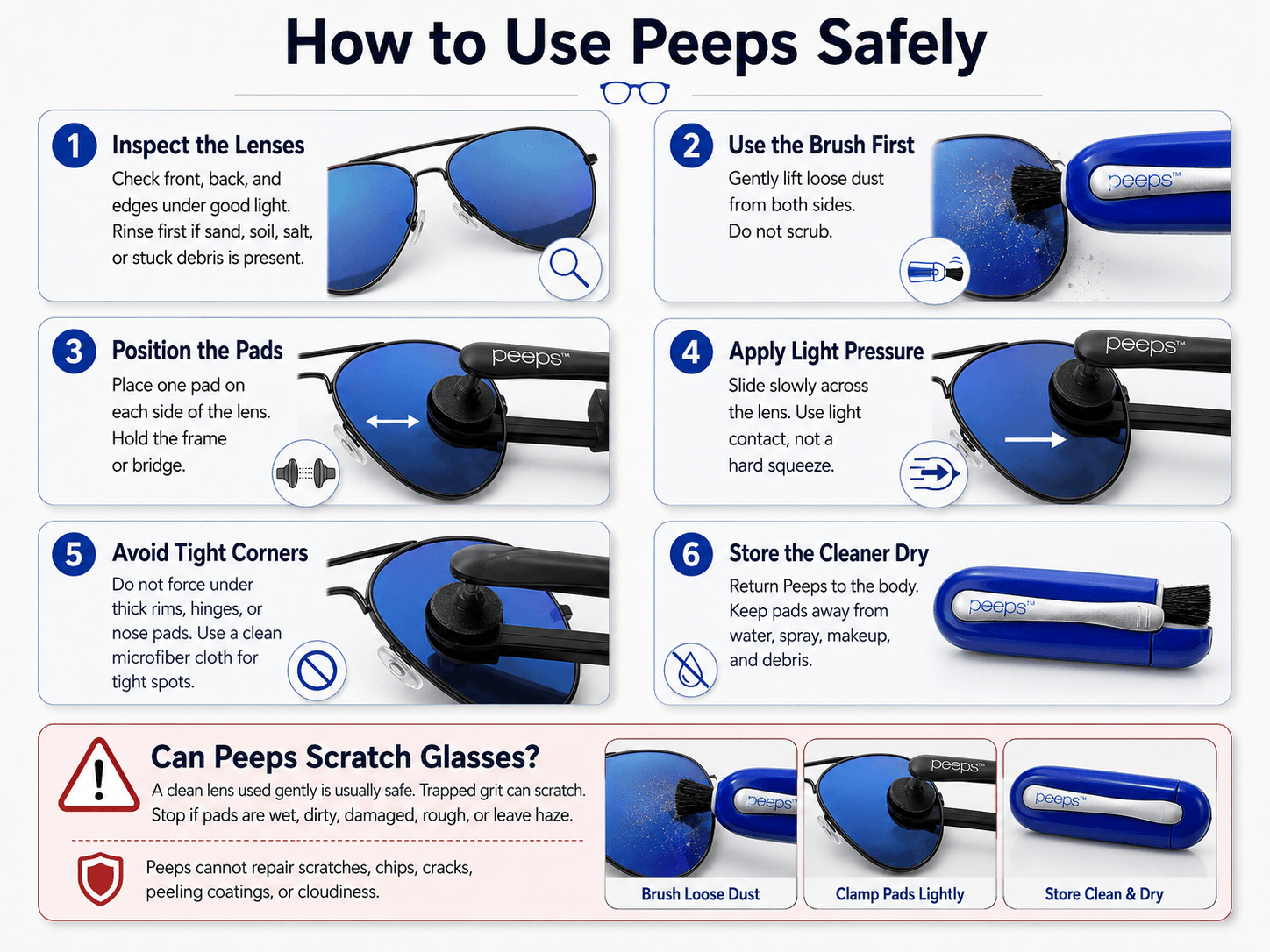
To use Peeps Safely, inspect the lenses, brush away loose particles, place the pads around the lens, and move them with light pressure. Stop if the cleaner drags or feels rough, and rinse the glasses instead when sand, salt, sticky residue, or visible grit is present.
1. Inspect the Lenses
Hold the glasses under good light. Check the front, back, and edges for dust, grit, dried residue, or anything stuck to the surface.
If you see sand, soil, salt, or a particle that does not move easily, rinse the glasses instead of immediately wiping them.
2. Use the Brush First
Extend the brush and move it gently across both sides of each lens. Do not scrub. The goal is to lift loose material, not force stuck debris away.
Pay attention to the edges because dust often collects near the bridge and frame.
3. Position the Pads
Open the cleaning arms and place one pad on each side of the lens. Hold the glasses by the frame or bridge so the lens is not twisted.
4. Apply Light Pressure
Move the pads slowly across the open surface. The cleaner needs contact, not a hard squeeze.
If it drags, squeaks, or feels rough, stop. More pressure will not make dried residue dissolve.
5. Avoid Forcing Tight Corners
The center of a lens should be easy to reach. Areas near thick rims, hinges, nose pads, and narrow corners may be more difficult.
A clean microfiber cloth may be better for those spots. Forcing the pad under a frame edge makes the process less controlled.
6. Store the Cleaner Dry
Return Peeps to their body after use. Keep the pads away from water, spray, makeup, and loose debris.
I did not find clear instructions recommending that the pads be washed. Unless the manufacturer provides model-specific guidance, I would not rinse, soak, or apply cleaning solution to them.
Can Peeps Scratch Glasses?
Peeps should not scratch a clean lens when it is used gently, but grit trapped between a pad and the lens can create damage. The safest routine is to brush away loose dust, rinse off sand or stuck debris, use light pressure, and stop when the pads feel rough or contaminated.
This is the most important safety point in the review.
A soft pad does not make every situation safe. The condition of the lens matters. A grain of sand or hard mineral particle can act like an abrasive once pressure is applied.
The same principle applies to microfiber cloths. The problem is not always the cleaning material itself; it may be the debris underneath it.
I would stop using Peeps when:
- The pads look visibly dirty.
- The pads have become wet.
- An edge is damaged or loose.
- The cleaner repeatedly leaves haze.
- The movement feels rough.
- The lens contains grit that cannot be brushed away.
Peeps also cannot repair existing scratches, peeling coatings, chips, cracks, or permanent cloudiness. Cleaning may make existing damage easier to see, but it does not restore the lens.
Is Peeps Safe for Coated Lenses?
The manufacturer markets Peeps for common prescription, anti-reflective, polarized, blue-light-filtering, photochromic, and other coated lenses. However, coating requirements vary, so owners of expensive or specialty eyewear should follow their optician’s care instructions before using any new dry-cleaning tool.
“Safe for all lenses” is a broad manufacturer claim. It should not be treated as independent proof across every lens material, coating formula, frame design, and age condition.
For ordinary glasses and sunglasses, the product is clearly intended for routine use. For premium or specialty eyewear, I would check the lens-care guide first.
Frame shape is another consideration. Very small lenses, strongly curved sunglasses, rimless glasses, and thick frame edges may be harder to clean with opposing pads. That may make a cloth or pen-style tool easier to control.
Peeps Pros and Cons
Peeps offers a convenient, reusable, liquid-free way to clean light smudges, but it does not replace proper washing. Its strongest benefits are portability and protected storage, while its main limitations are reduced performance on heavy residue, difficulty near frame edges, and the possibility of streaking when the pads become contaminated.
Pros
- Compact, all-in-one design
- Built-in brush removes loose dust first
- No separate spray or liquid required
- Reusable carbon-based cleaning pads
- Cleans both sides of a lens together
- Replacement pads are available
Cons
- Not suitable for heavy, sticky, or gritty residue
- May struggle near tight frame edges
- Dirty or damp pads may leave streaks
Peeps vs. Other Eyeglass Cleaning Methods
Peeps is better suited to quick, liquid-free touch-ups than deep cleaning. A microfiber cloth offers more flexibility, spray handles heavier residue, wipes provide sealed moisture for travel, and lens pens may reach tight areas more easily. The best choice depends on the type of dirt and where the cleaning happens.
| Buyer need | Better option | Reason |
| Quick fingerprint removal away from home | Peeps | Compact, dry, and self-contained |
| Heavy oil or dried residue | Lens-safe spray or proper washing | Liquid can loosen buildup |
| Drying freshly washed glasses | Clean microfiber cloth | Flexible and absorbent |
| Reaching narrow frame edges | Microfiber cloth or lens pen | Easier to control in small areas |
| Occasional wet cleaning during travel | Individually wrapped lens wipe | Sealed and pre-moistened |
| Lowest upfront cost | Microfiber cloth | Simple and inexpensive |
| Reducing disposable waste | Peeps or washable cloth | Both can be reused |
Peeps vs. a Microfiber Cloth
A clean microfiber cloth is cheaper, flexible, and useful for drying washed glasses. It can reach corners that Peeps may miss.
Its weakness is storage. A cloth tossed into a pocket or bag can collect oil, lint, and dust. Peeps keeps the brush and pads inside one body, giving it a portability advantage.
I do not see these tools as direct replacements for each other. Keep a cloth for washing, drying, and detailed cleaning. Use Peeps for quick dry touch-ups.
Peeps vs. Lens Spray and Cloth
Spray and cloth provide a more complete clean, especially for grease, makeup, and dried residue. The disadvantage is carrying two items and dealing with liquid.
Peeps is easier for travel. Spray and cloth remain stronger for deep cleaning at home.
Peeps vs. Disposable Lens Wipes
Individually wrapped wipes stay sealed and provide moisture. They can be useful for travel and for marks dry pads cannot remove.
Their downside is recurring cost and waste. Peeps can be reused, although their useful lifespan depends on pad condition rather than the advertised maximum alone.
Peeps vs. LensPen-Style Cleaners
Both products commonly use a brush plus a carbon-based cleaning surface. A traditional lens pen cleans one surface at a time and may offer better control near corners. Peeps cleans both sides together, which can be faster across open lens areas.
Common Peeps Complaints
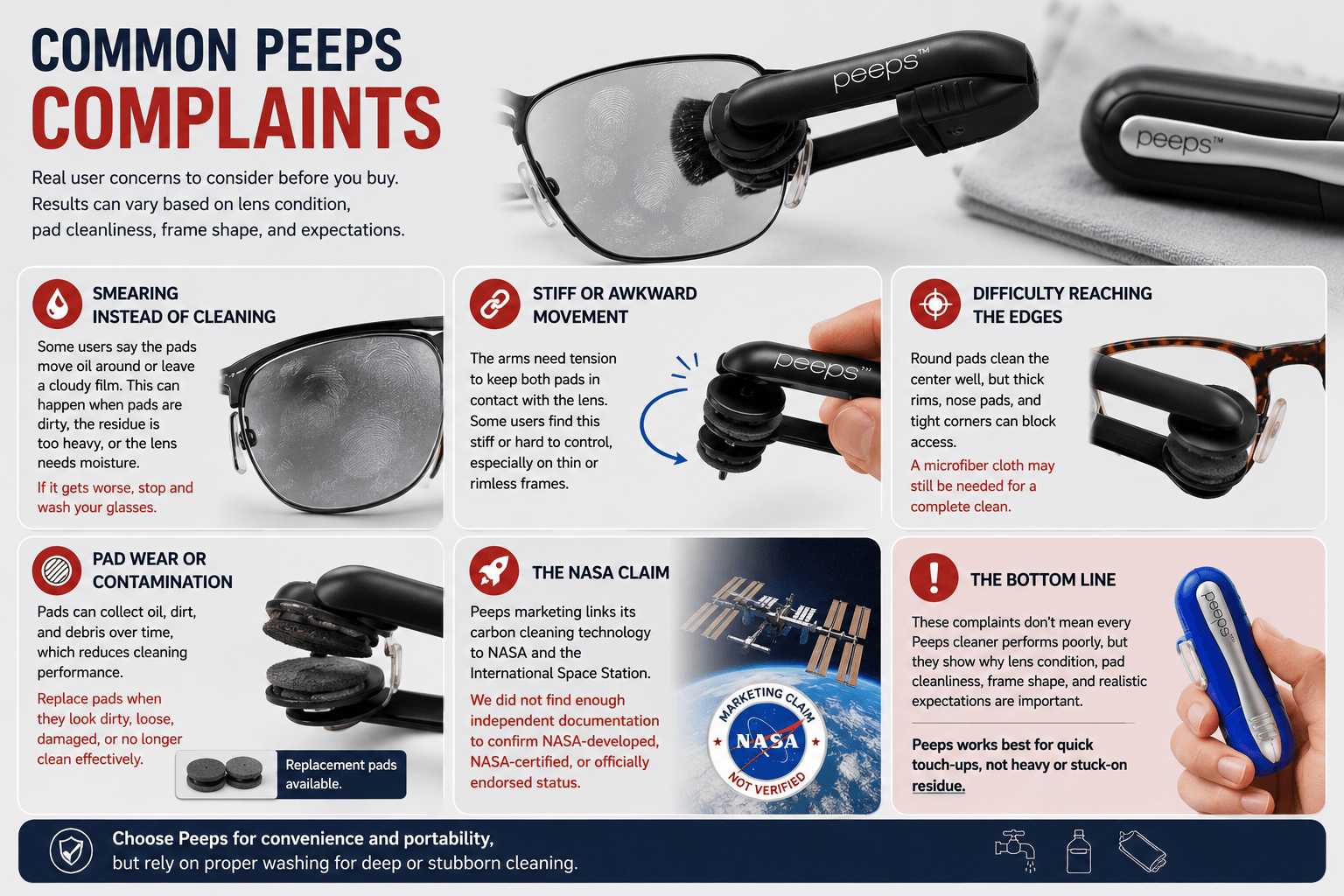
The most common Peeps complaints involve smearing, stiff movement, limited access near frame edges, pad wear, and confusion around marketing claims. These concerns do not mean every cleaner performs poorly, but they show why lens condition, pad cleanliness, frame shape, and realistic expectations matter.
Smearing Instead of Cleaning
Some buyers report that the pads move oil around or leave a cloudy film. This can happen when the pads are contaminated, the residue is too heavy, or the lens needs moisture rather than another dry pass.
If repeated passes make the lens worse, stop. Wash the glasses and inspect the pads.
Stiff or Awkward Movement
The arms need enough tension to keep both pads in contact with the lens. Some users may find that feel controlled, while others may consider it stiff.
This concern matters more with thin, delicate, or rimless frames. The cleaner should not need to be forced.
Difficulty Reaching the Edges
Round pads work best across the center of a lens. Thick rims, nose pads, and narrow corners can block access.
A microfiber cloth may still be necessary for a complete clean.
Pad Wear or Contamination
Replacement pads are available, which is better than throwing away the entire device. Pads should be replaced when they become loose, visibly dirty, damaged, or consistently ineffective.
The NASA Claim
Peeps marketing connects its carbon cleaning technology with NASA and the International Space Station. I did not find enough independent documentation to describe the retail cleaner as NASA-developed, NASA-certified, or officially endorsed.
I would treat the space-related wording as an unverified marketing claim. The buying decision should rest on the brush-and-pad design, not the NASA reference.
Peeps Price and Buying Options
A single Peeps cleaner costs $19.99. At first, that feels a little expensive for a compact glasses cleaner. However, it includes a retractable brush, cleaning pads, a protective body, and a reusable design, so I see it as more than a basic microfiber cloth.
Peeps Price Packages
| Package | Price | Average Price per Cleaner |
| 1 Peeps Cleaner | $19.99 | $19.99 |
| 3 Peeps Cleaners | $49.98 | $16.66 |
| 5 Peeps Cleaners | $74.97 | $14.99 |
| 10 Peeps Cleaners | $124.95 | $12.50 |
The larger packages reduce the cost per cleaner, but buying several immediately does not make sense for a first-time user. Prices and package deals can change, so check the current total before placing an order.
Is Peeps Worth $19.99?
For me, $19.99 feels reasonable when I need to clean my glasses several times throughout the day. Its small size makes it easy to keep in a pocket, handbag, desk drawer, or travel case.
The price does not cover only the cleaning pads. It also includes the built-in brush, protective storage, reusable construction, and the design that cleans both sides of a lens at the same time.
However, the value feels lower when I clean my glasses only occasionally or already get reliable results from a microfiber cloth and lens spray. Peeps focuses mainly on convenience, portability, and quick dry cleaning.
Should You Buy One or a Multipack?
I recommend starting with one Peeps cleaner for $19.99. This gives you enough time to test the cleaning results, check how the pads fit around your frames, and see whether the dry-cleaning method matches your routine.
After a successful trial, the three-pack becomes a practical choice for keeping one cleaner at home, one at work, and one in a travel bag. The five-pack and ten-pack suit families, households with several glasses wearers, or regular users who want a lower cost per cleaner.
Is Peeps Legit or a Scam?
Peeps is a legitimate commercial eyeglass cleaner sold under the CarbonKlean name and through major retailers. The product itself is real. The more important buyer concern is choosing a seller with clear pricing, trackable shipping, readable return terms, and dependable payment protection.
I would not assume that a promotional page is fraudulent simply because it looks aggressive. I would, however, slow down and verify the details before entering payment information. So, it is safe to buy from the official page.
What to Check Before Ordering
- Confirm whether the listing contains one cleaner, a multipack, or replacement pads only.
- Check whether optional products changed the cart total.
- Verify that the order is a one-time purchase rather than a subscription.
- Identify who sells and ships the product.
- Review the delivery estimate and tracking method.
- Read the current return window.
- Check whether opened items qualify for returns.
- Confirm whether replacement pads are original or only described as compatible.
- Use a payment method that offers a dispute process.
Is Peeps Worth It?
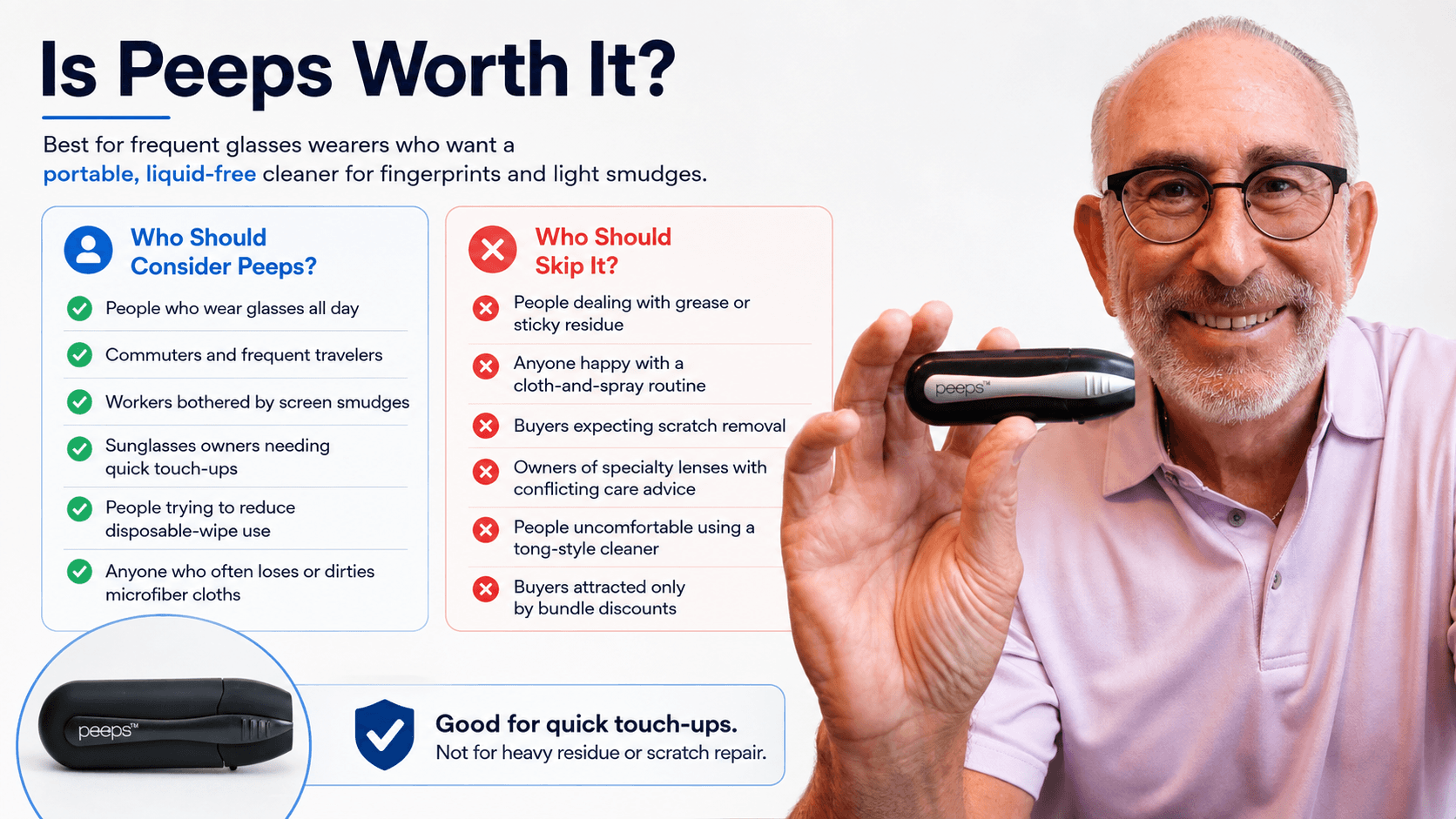
Peeps is worth considering for frequent glasses wearers who want a portable, liquid-free cleaner for fingerprints and light smudges. It is less compelling for occasional users, buyers who already protect a clean microfiber cloth, or anyone expecting it to remove heavy residue or repair scratches.
Who Should Consider Peeps?
The cleaner is a reasonable fit for:
- People who wear glasses all day
- Commuters and frequent travelers
- Workers bothered by smudges on bright screens
- Sunglasses owners who need quick touch-ups
- People trying to reduce disposable-wipe use
- Anyone who regularly loses or dirties microfiber cloths
Who Should Skip It?
Peeps is less suitable for:
- People who mainly deal with grease or sticky residue
- Anyone satisfied with a cloth-and-spray routine
- Buyers expecting scratch removal
- Owners of specialty lenses with conflicting care instructions
- People uncomfortable using a tong-style cleaner
- Buyers attracted only by a large bundle discount
My Buying Recommendation
I see Peeps as a secondary cleaner, not the only eyewear-care product a household should own.
Keep a clean microfiber cloth and an approved wet-cleaning method at home. Use Peeps when you are away from that setup and need to remove a fingerprint or light oily film quickly.
I would buy one unit first from a seller with clear delivery and return protection. I would not base the decision on the NASA claim, and I would not assume every pad set will deliver exactly 500 effective cleanings.
Frequently Asked Questions About Peeps
These FAQs answer the most common questions buyers ask before ordering Peeps, including how it cleans without spray, whether it can scratch lenses, how long the pads may last, and how it compares with a microfiber cloth. The answers separate manufacturer claims from practical buyer guidance.
Does Peeps Really Clean Glasses Without Spray?
Yes. Peeps is designed to remove light fingerprints, facial oil, dust, and everyday smudges without cleaning spray. Its carbon-based pads clean both sides of a lens after the retractable brush removes loose particles.
It is not the best option for grease, dried spots, sticky residue, or grit that needs to be rinsed away.
Can Peeps Scratch Eyeglasses?
Peeps should not scratch clean lenses when used gently. However, sand, dust, or hard debris trapped beneath the pads may damage the surface.
Always brush first, rinse off visible grit, avoid hard pressure, and stop using the device when the pads feel rough, wet, damaged, or contaminated.
Is Peeps Safe for Anti-Reflective and Coated Lenses?
The manufacturer markets Peeps for common prescription and coated lenses, including anti-reflective, polarized, blue-light-filtering, and photochromic eyewear.
Because coating requirements differ, owners of expensive or specialty lenses should follow the cleaning instructions supplied by their optician or lens manufacturer before using any new cleaning tool.
How Long Does a Peeps Cleaner Last?
The manufacturer claims the pads can provide up to 500 cleanings. The actual useful lifespan may be shorter or longer depending on how often the cleaner is used, what type of residue it contacts, and whether the pads remain clean and dry.
Replace the pads when they become loose, damaged, visibly dirty, or consistently streaky.
Can Peeps Pads Be Washed?
I did not find clear instructions recommending that Peeps pads be washed. Because the system is designed for dry use, I would not rinse, soak, or apply cleaning solution to the pads unless the manufacturer provides instructions for the exact model.
Replacement pads are the safer choice when the existing pads become contaminated or ineffective.
Does Peeps Remove Scratches?
No. Peeps removes surface dust, oil, and smudges. It cannot repair scratches, peeling coatings, chips, cracks, or permanent cloudiness.
A cleaner may make existing damage easier to see after surrounding oil is removed, but it does not restore the lens.
Is Peeps Better Than a Microfiber Cloth?
Peeps is more convenient for protected, liquid-free cleaning away from home. A microfiber cloth is cheaper, more flexible around frame edges, and better for drying freshly washed glasses.
Many buyers may benefit from owning both: Peeps for quick touch-ups and a clean cloth for washing, drying, and detailed cleaning.
Can Peeps Be Used on Wet Lenses?
Peeps is designed as a dry-cleaning tool, so I would not use it on wet lenses. Moisture may affect the pad surface and contribute to streaking or contamination.
After washing glasses, dry them with a clean lens-safe microfiber cloth. Save Peeps for later fingerprints and dry smudges.
What Should I Check Before Ordering Peeps?
Check the seller, package quantity, current price, shipping estimate, return policy, and whether the listing includes a complete cleaner or replacement pads only.
First-time buyers should consider one unit before ordering a multipack, especially when they are unsure how the pad shape will work with their frame.
Final Verdict
This Peeps Eyeglass Cleaner Review finds that Peeps is a practical touch-up tool, not a miracle cleaning system. Its built-in brush, opposing pads, protected storage, and liquid-free design make sense for people who frequently notice fingerprints while working, commuting, or traveling.
The cleaner deserves realistic expectations. It is designed for light maintenance, not grease, sticky residue, or gritty lenses. It should be used only after loose particles are removed, and broad claims such as all-lens compatibility and up to 500 cleanings should remain attributed to the manufacturer.
For the right buyer, one Peeps cleaner can be a useful addition to a desk, bag, or glasses case. For someone who already protects a clean microfiber cloth and rarely needs on-the-go cleaning, the extra cost may not be justified.
The strongest reason to buy Peeps is convenience. The strongest reason to skip it is that a basic cloth may already solve the same problem for less money.
Peeps By CarbonKlean is an advanced quality eyeglass cleaner that implements the latest aerospace technology to clean your lenses without getting streaks. The device works by producing ions that loosen the dirt and grime and make it easy to wipe away
- Built with high-quality materials
- Safe to clean all types of lenses
- Very lightweight and portable
- Approved By NASA
- Sometimes pads fall off
- Need to change the pads after 500 times
