
I kept postponing the stories I feared losing.
I wanted to preserve my family’s memories, but I faced a practical problem: I did not know which questions to ask, how to organize the answers, or how to convince an older relative to write long stories. A blank journal felt like more work, not a real solution.
That is where Memorygram may help.
Memorygram is a guided memoir service that turns written or spoken memories, photographs, and voice recordings into a personalized hardcover book. Storytellers can type answers, record them online, or respond through scheduled U.S. phone calls without needing an app or smartphone.
The phone option is especially useful for parents and grandparents who enjoy talking but dislike typing. Memorygram provides the prompts, converts spoken answers into editable text, and preserves the original voice through QR-linked recordings.
This Memorygram Review examines how it works, current pricing, key features, limitations, customer feedback, and whether it offers real value for families.
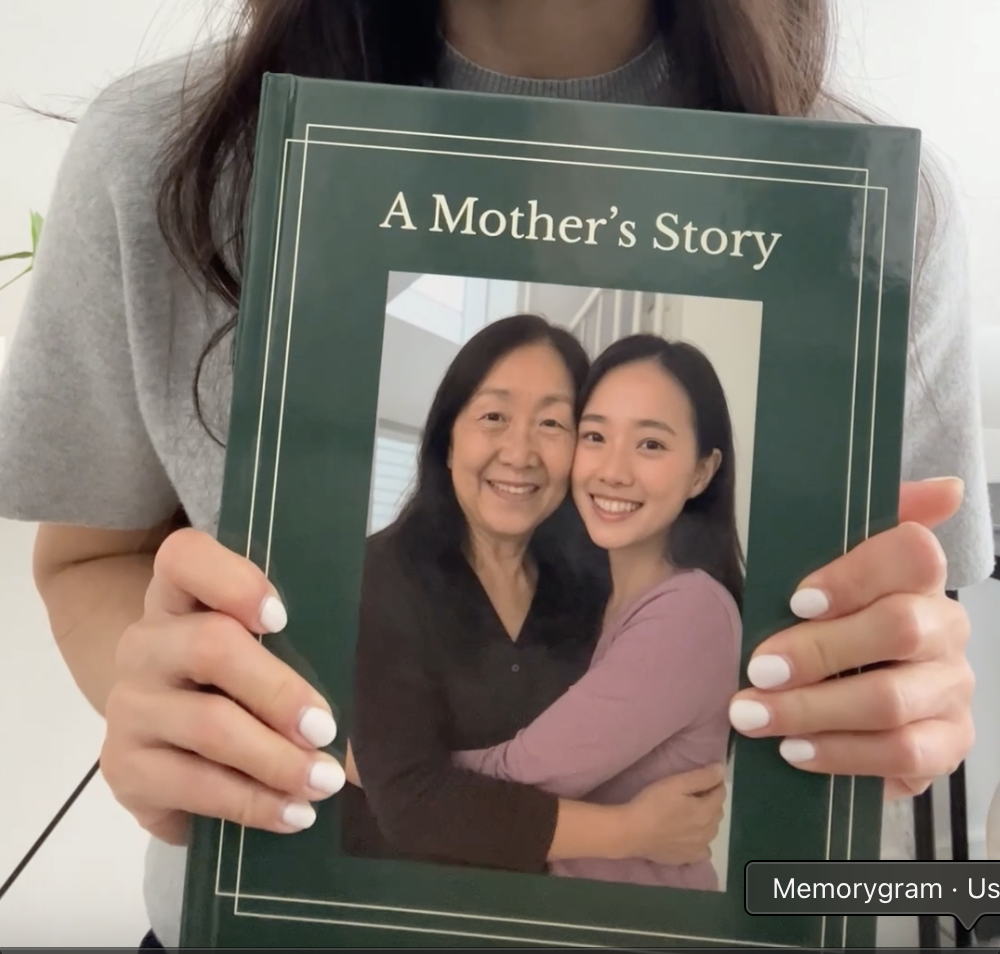
Memorygram is a guided memoir service that turns written or spoken memories, photographs, and voice recordings into a personalized hardcover book. I liked its scheduled phone interviews, editable transcripts, QR-linked audio, flexible prompts, and accessibility for older adults who prefer speaking to typing. However, families still need to proofread, organize photos, verify pricing, and remain involved before the final book is approved.
- Multiple ways to tell stories
- Phone interviews work without an app
- Preserves original voice recordings
- Large full-color hardcover included
- Custom questions and photos supported
- Requires proofreading and family involvement
- Phone interviews require a U.S. number
- Extra copies and add-ons increase cost
Quick Verdict
Memorygram is worth considering for families who want a structured, long-term way to preserve personal history. It offers the most value when the storyteller is willing to participate and another family member can help manage photos, editing, and final approval.
Best for: Engaged families creating a meaningful keepsake.
Main advantage: A flexible, organized memoir-building process.
Main drawback: It is not an instant or fully hands-off gift.
What Is Memorygram?
Memorygram is a guided storytelling platform that helps families turn personal memories, photographs, and audio recordings into a printed Legacy Book.
Instead of giving someone an empty journal and expecting them to know where to begin, the platform provides questions about childhood, family, education, work, relationships, traditions, challenges, and personal lessons.
The storyteller can use the available questions, remove prompts that feel irrelevant, rearrange their order, or create custom questions.
That flexibility matters because the most valuable family stories are often too specific for a general question library. I would want to ask about particular relatives, neighborhoods, businesses, migrations, traditions, or turning points rather than relying only on broad prompts.
Memorygram supports up to approximately 60 selected questions. However, that does not guarantee 60 completed stories. People using the scheduled phone feature typically create around 35 to 55 stories, depending on how many calls they complete.
You can purchase Memorygram for yourself or send it to someone else as a gift. When buying for another person, you can add their information, write a personal message, and choose when the digital invitation should arrive.
The invitation may be delivered immediately, but the finished hardcover book comes later. Memorygram is better understood as a storytelling experience that eventually produces a physical keepsake, not an instant completed gift.
How Does Memorygram Work?
Memorygram works by collecting guided answers, converting spoken stories into editable text, adding photographs, and arranging everything into a customized hardcover book.
The process is straightforward, but families should expect to remain involved from the first question through final proof approval.
1. Select the Questions
After the account is created, the storyteller or purchaser chooses which questions to include.
The default pace is one question per week, but users can adjust the frequency, answer several prompts in one session, skip a question, or return to earlier stories later.
I would avoid choosing every possible prompt immediately. Starting with questions connected to memorable people, places, and events may make the experience feel more personal and less like homework.
2. Choose How to Answer
The storyteller can respond in three main ways:
- Type the story inside the online platform
- Use online voice-to-text
- Answer during a scheduled telephone call
The scheduled phone feature works with U.S. telephone numbers, including landlines. It does not require a smartphone, app, or internet connection.
During the call, an automated interviewer asks a question and may provide follow-up prompts that encourage more detail. For example, it may ask who was present, what happened next, or how the person felt.
Most calls last around 5 to 15 minutes, although the storyteller may speak for up to 30 minutes.
Someone who misses a call does not lose access to the entire project. They can continue with a future scheduled interview, answer online, or call when they are ready to record another memory.
3. Edit the Transcript
Spoken answers are converted into editable written stories while the original audio is preserved.
Automated transcription can save considerable time, but it should not be treated as a perfect final draft. Names, locations, dates, accents, and family expressions may be misunderstood.
A family member can review the text, correct mistakes, improve punctuation, and remove repeated wording before the story is printed.
I would divide the responsibilities whenever possible. Let the storyteller focus on remembering and speaking while someone else handles spelling, photographs, dates, and layout.
4. Add Photographs
Photographs can be uploaded and placed beside the related stories.
This could include family portraits, childhood photos, homes, documents, travel pictures, wedding images, workplace memories, or meaningful objects.
Adding photographs early is easier than searching for everything just before printing. It also gives the family time to scan older images, confirm who appears in them, and write accurate captions.
5. Preview the Book
Memorygram provides a reusable PDF preview that shows how the book will look.
Users can rearrange questions, revise the text, change photographs, adjust the order, and customize the cover with a title, author name, and image.
The preview can be generated more than once, so there is no reason to approve the first version immediately.
6. Approve It for Printing
The book is printed after the customer approves the cover and interior proof.
That approval is important because mistakes already visible in the proof generally remain the customer’s responsibility. A misspelled surname, wrong year, duplicated photo, or missing paragraph may not qualify for a free correction.
Clear manufacturing defects may be eligible for replacement, but content mistakes normally require purchasing another copy.
I would ask at least one additional family member to review the final proof before approving it.
Memorygram Features and Specifications
Memorygram combines guided prompts, phone interviews, audio recordings, photographs, book design, and printing in one memoir service.
| Feature | Memorygram Legacy Book Details |
| Product type | Guided memoir and storytelling service |
| Book format | Full-color hardcover |
| Book size | 8.5 × 11 inches |
| Maximum length | Up to 450 pages |
| Question capacity | Up to about 60 selected prompts |
| Typical phone-story range | Around 35–55 completed stories |
| Response options | Typing, online voice-to-text, scheduled phone calls |
| Photographs | Can be uploaded and arranged before printing |
| Audio access | QR codes connect readers to saved recordings |
| Preview | Reusable PDF proof generator |
| Included physical book | One hardcover copy |
| Legacy Book billing | One-time purchase without automatic annual renewal |
| Phone compatibility | U.S. telephone numbers only |
Scheduled Phone Interviews
The phone interview is the feature that most clearly separates Memorygram from a standard writing-based memoir service.
A storyteller can answer a familiar telephone and speak naturally without logging into a website. This may remove a major barrier for an older adult who enjoys conversations but avoids email, apps, or long typing sessions.
However, the call is automated rather than a live interview with a professional biographer. Some people may enjoy that privacy, while others may respond more naturally to a family member or human interviewer.
Voice Recordings and QR Access
Memorygram preserves the original recording and connects it to the printed book through QR codes.
This adds something a written memoir cannot fully reproduce. The printed transcript records what happened, while the audio can preserve personality, humor, emotion, and the storyteller’s natural voice.
I would still download and save the recordings separately. Hosted QR content should not be the family’s only copy of irreplaceable audio.
Multiple Storytellers
An additional storyteller can be added to the same book for an extra fee.
This may work well for:
- A mother and father creating one family history
- A married couple describing shared experiences
- Siblings remembering childhood differently
- Multiple relatives contributing to one themed book
Separate authors who each want an individual book generally require separate Legacy Book purchases.
Language Support
Memorygram offers a separate Spanish Legacy Book with Spanish questions, platform support, and book content.
Stories may also be typed in other languages, although the primary management interface remains in English.
Automated voice-to-text currently supports English. A family recording in another language may need to manually replace the transcript while keeping the original audio.
Book Size and Length
The Legacy Book is described as an 8.5 × 11-inch, full-color hardcover that can contain up to 450 pages.
That gives it more visual space than a small journal and should work well for stories paired with family photographs.
The product page does not clearly guarantee glossy photo-book paper, a specific paper thickness, or premium archival materials. Buyers who prioritize luxury photo printing should keep that distinction in mind.
Completion Timeline
Memorygram says most customers complete their books in around six to eight months.
More active storytellers may finish in two to three months by answering several questions each week.
For a major holiday, the company recommends submitting the approved book roughly 2.5 weeks before the date to allow time for printing and delivery.
I would plan for more time rather than less. Collecting photographs and proofreading usually takes longer than expected.
What Is Included With Memorygram?
A Memorygram purchase includes the storytelling platform, one year of questions, writing and voice tools, photo support, audio access, and one printed hardcover book.
The official offer lists:
- One 8.5 × 11-inch hardcover book
- Full-color printing
- One year of questions
- Unlimited stories and sharing
- Typed and spoken response options
- Photograph uploads
- Editable transcripts
- QR-linked voice recordings
- Reusable PDF previews
- No automatic Legacy Book renewal
The product page contains an important digital-copy inconsistency.
One section says a downloadable PDF e-book is included. However, the product form and another FAQ advertise a shareable browser or PDF digital version for $19.99 extra.
The safest interpretation is that the editing preview is included, while the finished shareable digital edition may require an additional payment.
Buyers should confirm exactly what digital format is included before completing the order.
Memorygram Price and Additional Costs
Memorygram’s official product page currently displays different prices in different places, so buyers should verify the final cart total.
As checked on August 2, 2026, the main product selector displayed $123.50, while another section advertised a promotional price of $98.80.
| Item | Displayed Amount |
| Legacy Book product price | $123.50 |
| Promotional price shown elsewhere | $98.80 |
| Additional book with current order | $77 |
| Regular additional-copy price | $89 |
| Additional storyteller | $50 |
| Shareable digital-copy option | $19.99 |
| International shipping | Calculated by destination |
Prices and promotions may change, and the cart total should be treated as the final current price.
Additional Printed Copies
One printed book is included.
Extra copies are currently advertised at $77 each when added with the order, compared with a stated standard price of $89.
This is where the total can increase quickly. Three additional copies at $77 would add $231 before shipping or taxes.
Before ordering, I would ask relatives how many copies they may want. A family memoir often becomes something siblings, children, and grandchildren each want to keep.
Additional Storyteller
Adding another storyteller to the same book currently costs $50.
This may be worthwhile for a couple creating one shared memoir, but buyers should confirm how the stories will be arranged before adding the option.
Digital Copy
A shareable digital version is listed at $19.99, although the product page is unclear about how this differs from the included PDF preview.
Confirm the exact digital access before paying for the upgrade.
Shipping
Memorygram ships internationally, with international delivery costs calculated based on the destination when the book is ready for printing.
International buyers may also be responsible for customs fees, taxes, or import charges.
The reviewed product page does not clearly establish one universal U.S. shipping cost. Domestic buyers should check the current offer rather than assuming delivery is always free.
Is Memorygram a Subscription?
The Memorygram Legacy Book is presented as a one-time purchase without automatic annual renewal.
Memorygram sells other products and services that may involve recurring billing, but those should not be confused with the Legacy Book offer.
Is Memorygram Easy for Older Adults?
Memorygram can be easier for older adults because its scheduled phone feature works without a smartphone, app, or internet connection.
A person can answer a regular U.S. telephone or landline and tell the story aloud.
This may suit someone who:
- Enjoys talking about the past
- Dislikes writing long answers
- Rarely uses email
- Finds apps confusing
- Feels more comfortable with a phone
Still, I would not describe Memorygram as completely effortless.
The storyteller may need help understanding why the calls are arriving, choosing a schedule, correcting transcripts, adding photographs, and reviewing the finished book.
Hearing difficulties, memory challenges, speech limitations, or anxiety around automated calls may also affect the experience.
Before buying, ask the recipient whether they would actually enjoy answering guided questions by telephone. A meaningful product is still a poor gift when the recipient does not want to participate.
Transcription, Audio, and Print Quality
Memorygram’s transcription provides a useful starting point, but families should manually review the text before approving the book.
Automated systems may misinterpret:
- Family names
- Towns and countries
- Dates and ages
- Accents
- Unusual phrases
- Overlapping speech
Memorygram says its system removes some filler words and turns recordings into more readable stories. However, this is not the same as hiring a professional editor or biographer.
The platform provides tools, structure, and automation. It does not independently research, verify, or professionally rewrite the storyteller’s life.
What to Check in the Final Proof
Before printing, review:
- Names and relationships
- Dates and timelines
- Story titles
- Missing or repeated text
- Photo resolution
- Captions
- Chapter order
- Cover spelling
- Author name
- Blank pages
- Awkward page breaks
Customer reviews provide some additional context about the final product.
One reviewer described the pages as having a matte finish, while another said the recording feature was useful but felt the audio quality could be improved.
These are individual experiences rather than guaranteed specifications.
The official terms also warn that printed colors, cropping, trimming, and layout may vary slightly from what appears on a screen.
Privacy, Content Ownership, and AI Use
Memorygram stores deeply personal content, so buyers should understand how stories, photographs, and voice recordings are handled.
The company says users retain ownership of uploaded memories.
It also states that personal stories, photographs, and recordings are not sold or used for marketing without express written permission.
Memorygram uses third-party providers for areas such as:
- Payment processing
- E-commerce
- Hosting
- Telephone services
- Audio transcription
- Voice-file processing
Its privacy policy identifies business accounts with companies such as OpenAI and ElevenLabs for AI-related processing.
Memorygram says its contracts prevent those providers from using customer stories and voice files to train their models.
No online service can guarantee zero security risk. I would avoid uploading unnecessary sensitive information and keep private backups of every important recording and finished file.
Memorygram Refund Policy
Memorygram offers a 30-day refund period from the purchase date, provided that no book has been printed.
Once a customized book enters production, it generally cannot be returned or exchanged.
The company says it may:
- Refund an eligible unprinted order
- Replace a clearly defective product
- Address a production problem
- Transfer the membership to another storyteller
The transfer option could be helpful when the original recipient decides not to continue.
However, the refund policy does not protect buyers from mistakes they approve in the final proof.
If the wrong date, spelling, photograph, or layout appears in the approved version, the customer may need to purchase a corrected copy.
Is Memorygram Legit or a Scam?
Memorygram appears to be a legitimate guided memoir service operated by an identifiable U.S. company.
It has:
- A functioning official website
- Public contact information
- Published refund and privacy policies
- Customer reviews describing delivered books
- A Better Business Bureau profile
- A stated pre-print refund period
The BBB lists Memorygram as an accredited Austin, Texas business with an A rating. Its profile says the business began operating in 2017 and became accredited in November 2025.
The profile also records customer complaints. That does not mean the company is fraudulent, but it shows that buyers have experienced service issues.
BBB accreditation is not a guarantee or endorsement.
Based on the available information, Memorygram is a real product sold by an operating business—not an anonymous scam site. Buyers should still save order records, verify live pricing, and carefully review the final proof.
Memorygram Pros and Cons
Memorygram’s main advantages are its flexible storytelling methods, phone accessibility, preserved audio, and large full-color book. Its drawbacks include U.S.-only phone support, required proofreading, and potentially expensive add-ons.
Memorygram vs. Storyworth, Remento, and My Life in a Book
Memorygram is best suited to telephone-based storytellers, while its main competitors may offer better value for writers, digital recorders, or budget-focused buyers.
| Service | Starting Price Checked Aug. 2, 2026 | Included Book | Main Strength |
| Memorygram | $123.50 displayed; $98.80 promotion elsewhere | 8.5 × 11-inch full-color hardcover, up to 450 pages | Scheduled U.S. calls and linked audio |
| Storyworth Basic | $59 | Hardcover with black-and-white interior | Lower-cost writing-first option |
| Storyworth Color | $109 | Full-color hardcover | Weekly prompts and voice recording |
| Remento | $99 | Full-color hardcover | Strong voice-first digital experience |
| My Life in a Book | $79 | Full-color keepsake book | Lower price and simple guided memoir process |
Memorygram vs. Storyworth
Storyworth may be better for someone who enjoys writing and responding through weekly digital prompts.
Its lower-priced Basic plan offers a more affordable entry point but uses a black-and-white interior. Higher plans add full-color printing, voice features, and guided phone interviews.
Memorygram is more compelling when ordinary telephone access is central to the purchase decision.
Memorygram vs. Remento
Remento is a strong alternative for people comfortable recording through a digital device.
It uses audio or video recordings and can turn them into cleaned transcripts or more polished narratives. The original recordings remain connected to the printed book.
Remento may feel more modern and digitally streamlined. Memorygram may be easier for someone who simply wants to answer a regular telephone.
Memorygram vs. My Life in a Book
My Life in a Book may offer stronger value for budget-conscious users who are comfortable typing or using online voice tools.
It currently offers a lower starting price, a high page limit, and multilingual question options.
Memorygram’s main reason to cost more is its scheduled U.S. telephone interviewer and larger standard book format.
Who Should Buy Memorygram?
Memorygram is best for a willing storyteller who prefers speaking and has someone available to help manage the final book.
It may suit:
- Parents and grandparents
- Older adults who use landlines
- Couples creating a shared memoir
- Families living in different locations
- People who value recorded voice
- Families willing to help with photos and editing
Who Should Skip Memorygram?
Memorygram may not suit:
- A recipient who dislikes personal questions
- Someone unlikely to participate consistently
- Buyers needing a finished book immediately
- International users who require scheduled phone calls
- Families wanting a fully written professional biography
- Buyers mainly seeking a glossy photo album
- Anyone uncomfortable storing personal memories online
What to Check Before Ordering
Before buying Memorygram, confirm that the storyteller wants to participate, choose the easiest response method, and calculate the full cost of every copy and add-on.
Ask:
- Will the recipient actually enjoy answering questions?
- Would they rather type, record online, or use phone calls?
- Who will organize photos and correct transcripts?
- How many printed copies will the family need?
- Is there enough time before the intended occasion?
- Which recordings should be backed up privately?
- What price appears in the final cart?
Is Memorygram Worth It?
Memorygram can be worth the price when preserving the storyteller’s voice matters as much as creating a printed memoir.
Its value comes from combining guided prompts, phone calls, transcription, photographs, audio access, layout, and printing in one system.
Creating the same result independently would require separate recording, transcription, design, file management, and printing tools.
However, the value becomes weaker when the storyteller is unlikely to participate or when the family needs several copies on a limited budget.
For me, the clearest buyer is a U.S.-based family with a talkative parent or grandparent who dislikes typing but enjoys sharing memories by phone.
Final Memorygram Review
This Memorygram Review finds that the service offers a practical way to preserve family stories, photographs, and a loved one’s real voice.
Its scheduled telephone feature gives it a meaningful advantage for older adults who may never complete a writing-based memoir. The large full-color book, custom questions, photographs, and linked audio also make the final project more personal than a standard journal.
The weaknesses are mostly practical.
The product page currently shows inconsistent pricing and digital-copy information. Extra family copies can become expensive, telephone interviews require a U.S. number, and every transcript and proof should be checked carefully.
I would recommend Memorygram for a willing parent, grandparent, or couple who prefers speaking to writing and has one organized family member available to support the project.
I would skip it when the recipient feels pressured, the book is needed immediately, or the buyer expects a professionally written biography with minimal involvement.
Before ordering, confirm participation, calculate the complete family-copy cost, and verify the live cart price.
Frequently Asked Questions
These Memorygram FAQs cover practical family concerns that may not be obvious from the sales page, including collaboration, missed calls, sensitive memories, organization, and joint storytelling.
Can Family Members Help With the Same Memorygram Book?
Yes. Relatives can contribute stories, upload photographs, and help edit the project, allowing the storyteller to focus on remembering while another person manages technology, captions, dates, organization, and final proofreading.
What Happens if the Storyteller Misses a Scheduled Call?
Missing a scheduled call does not cancel the project. The storyteller can continue with a later interview, answer through the online account, or return to unfinished questions whenever they feel prepared.
Can Memorygram Be Used for Sensitive or Private Stories?
Families control what appears in the final book and can edit or remove material before printing. Avoid unnecessary sensitive details and store private backups of recordings that should remain within the family.
Can Stories Be Reorganized After They Are Added?
Yes. Users can rearrange questions, revise written stories, replace photographs, and regenerate the PDF proof before approval, making it possible to organize the memoir by timeline, theme, location, or family member.
Is Memorygram Suitable for a Joint Family History?
It can work well for couples or relatives contributing to one book. Agree on story order, photograph ownership, sensitive subjects, and final wording early to reduce confusion or disagreements during editing.
Memorygram is a guided memoir service that turns written or spoken memories, photographs, and voice recordings into a personalized hardcover book. I liked its scheduled phone interviews, editable transcripts, QR-linked audio, flexible prompts, and accessibility for older adults who prefer speaking to typing. However, families still need to proofread, organize photos, verify pricing, and remain involved before the final book is approved.
- Multiple ways to tell stories
- Phone interviews work without an app
- Preserves original voice recordings
- Large full-color hardcover included
- Custom questions and photos supported
- Requires proofreading and family involvement
- Phone interviews require a U.S. number
- Extra copies and add-ons increase cost
